Fluency is the ability to speak a language with ease, without any hiccups! Now, you must be wondering what I mean by ‘without any hiccups’. Do not take that literally! It is an idiom. An idiom is a group of words whose actual meaning is different from the
literal meaning. ‘Without any hiccups’ does not mean speaking a language without
suffering from a bout of hiccups, what it means is speaking a language without stopping
and stuttering, and being unsure of how to use your words. Fluency means knowing how
to use your words with ease and comfort.
Fluency comes with practice. You cannot study every “How to speak English” book and expect to be fluent in the language. Practice is a must! Also, if you think you read well and so you must be fluent as well, you are mistaken! Reading and speaking are very different.
The thing with learning English is that you need not concentrate on the grammar while
speaking. Concentrate on conversing. English is a weird language with a lot of
loopholes.
1. Practice
Practicing speaking in English is a must. You cannot learn how to speak fluently
otherwise. The reason for this is the slang that has infiltrated the language and also the
utter lack of regard for grammatical rules while speaking. However, if one starts using
correct grammar, by the book, English would sound extremely weird.
Read more: Top Linking Words for Speaking
2. Small talk
Learn how to begin a conversation. This will also grow your confidence. While
standing in line, ask the person in front or behind you a simple question such as ‘What
time is it?’ Try continuing with the conversation. If you have trouble understanding the
person, politely ask them to repeat what they said. Normally, people say “I’m sorry?”
but you could also say “Pardon”.
How to Speak English Fluently like American Speakers in one Month
3. Confidence
Practicing English speech will require confidence. During a social gathering, start small conversations. Do not hesitate to ask the person to repeat him or herself. If you do not understand the meaning of a particular word or phrase, ask them to clarify. Chances are they know you are in the learning process and would gladly help. Do not think that you
can go home and open Google translations and type in the word or phrase they used.
This does not work! Also, do not feel embarrassed when somebody corrects you. You
could also go to a karaoke bar!
4. Listen
Reading and speaking is not enough. Listen to how people speak, the pronunciations,
and the way words are use. Watch T.V., listen to songs etc. This way you are listening
to other people speak and observe how they pronounce the words.
Learn more: How to Improve Listening Skill Effectively? (without spending extra time)

5. Read books
Read novels. Concentrate on the formation of the sentences. Novels have dialogues, a conversation between two people that you can use to your advantage. Notice how
people speak. They do not pay attention to the grammar as much as they do to talking.
Also, when you are reading, mark every unusual phrase or word and find out what it
means. Incorporate new words into your vocabulary.
5. Do not translate
Avoid translating what you hear, or what you say. Translating a phrase from your
mother tongue to English or vice versa will completely ruin the actual meaning of the
phrase. It will also most likely be incorrect. Instead, use a dictionary.
6. Study words and phrases
I’ve been using the term ‘phrases’ a lot. You may know a thousand words in the
language, but putting them together and making an intelligible sentence could be
difficult. This is because you are not concentrating on using the words you are learning.
To speak fluently, you need to learn how to put words together into phrases and
sentences.
Learn more: 1500 Real English Phrases from Beginner to Advanced
7. Idioms
Idioms are an essential part of the English language. You will find yourself dumbstruck
if you do not understand idioms. You might hear somebody saying ‘break a leg’ to you
before your English exam, and you would be baffled at why somebody would want you
to break a leg. ‘Break a leg’ is actually an idiom meaning ‘best of luck’ or ‘I hope you
do well’. Fluency in English requires the knowledge of idioms.
Learn more: Speaking English Fluently like Native Speakers through 901 perfect English Phrases
8. Do not think of yourself as a student
To become fluent, think of yourself as a person who can speak English. You will make mistakes, but these are the building blocks. As a student, you would probably find
yourself studying Grammar books. This is not important. To speak English properly, you
do not need to study Grammar books. You would also be wasting a lot of your time by
reading these books.
9. Recruit a friend as a mentor
An English-speaking friend is the perfect person to be with when learning the language. Surrounding yourself with people who can speak English fluently is important. You can ask a friend to help you along the way. Make it a point to talk in English, no matter how scattered it sounds. Ask friends and colleagues to correct you if you are wrong.
10. Movies and songs
Build a library of English songs and movies. This works better than just reading or
listening to others speak. Songs and movies stick to your mind. ‘My Fair Lady’ is a
good movie to watch since you are learning English.
Learn more: Learn English through Movies – 4 Tips, New method and Tool

11. Think in English
Make it a point to think in English and not your mother tongue. Whenever you are talking to yourself or thinking, do it in English. This way you will become more comfortable
with the idea of speaking and learning the language.
12. Record yourself
Every night before going to bed, record your day’s events in an audio journal in English. You will find that you speak much better when you do not have to worry about
embarrassing yourself in front of others. When you realize that you can speak reasonably
well without stumbling around, your confidence will grow and you will find yourself
initiating conversations.
Incorporate these points in your day-to-day life.
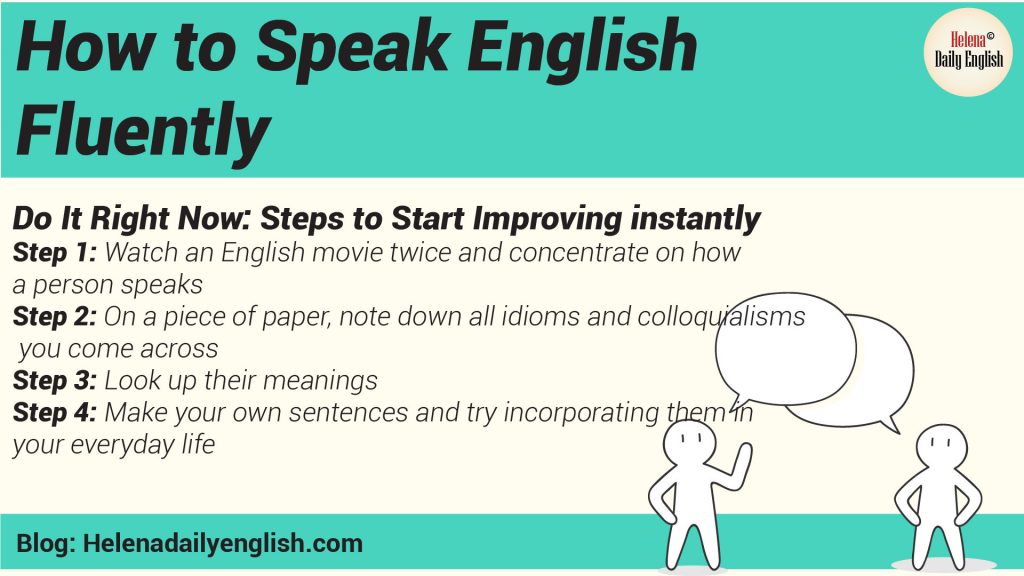
“Do It Right Now”: Steps to Start Improving instantly
Step 1: Watch an English movie twice and concentrate on how a person speaks
Step 2: On a piece of paper, note down all idioms and colloquialisms you come across
Step 3: Look up their meanings
Step 4: Make your own sentences and try incorporating them in your everyday life
Author: Edward Clemons
According to the book: How to Speak English Fluently in 1 Week
English Book: The New Oxford Picture Dictionary (Pdf) Download
The post How to Speak English Fluently | English Speaking Tips first appeared on Helena Daily English.]]>If you want to improve your English speaking skill, the only thing you can do is to practice. However, learning through grammar or listening to English alone will never help you. You have to speak out sentences to improve your speaking skills. So the question is how to deal with some matters you are facing:
Firstly, if you don’t have any friends to practice speaking English with you, what can you do?
There is an English-speaking tip for you to actually speak for yourself. This method also helps to improve your grammar, vocabulary, and sentence structure. Especially after you practice this technique regularly, you can feel confident to express your ideas in English.
And the key is “ IMITATION”.
It doesn’t mean that you repeat exactly what you hear from the native speaker.
For example:
Nice to meet you. My name’s Hana
Repeat: Nice to meet you. My name’s Hana
What I mention is to paraphrase what you hear in your own sentences on some different levels. Here are some steps:
The first step, change it to the different subjects like:
For instance, you will hear:
- I’m 18 years old and I still live with my parents
She’s 18 years old and she still lives with her parents.
- I had to go on a diet with my wife last month
He had to go on a diet with his wife last month
- We have worked for this company for almost 20 years
They have worked for this company for almost 20 years
Second, instead of repeating, you can develop the ideas by giving the detail of what happened in the past and something planned for the future.
===============
For example, with the above sentence:
- I’m 18 years old and I live with my parents
You can describe more by yourself such as:
She used to live with her grandparents when she was a little girl and then when she turns into 18, she moves to live with her parents but in the future, she will try her best to buy her own house to live independently.
Or
- I had to go on a diet with my wife last month
You can add some results you get like:
He had to go on a diet last month with his wife last month and now he is so proud that they all have perfect body shapes.
So obviously, by paraphrasing and developing ideas like that, you can learn more about grammar as well as improve your ideas and your vocabulary.
After learning how to change one sentence, you should challenge yourself by trying paraphrasing a larger portion of your speech, your conversation, or even your full story. You can give more information in the speech, learn to apply some linking words, add more adjectives and adverbs to objects or people or even change different sentence structures.
For instance, with the speech below:
My daily routine is like other people’s. I get up at 6.30 and then I brush my teeth and have breakfast 30 minutes later. At about 7.30, I go to school on foot and start my school time at 8.00
You can imitate with more advancements like:
His daily routine is normally like other people’s. He gets up at 6.30 and brushes his teeth before he has breakfast at approximately 7. And then, 30 minutes later, he is and walks to school because he forgot to repair his bike yesterday. It takes him 20 minutes to arrive at school and luckily, he still has 10 minutes left to take a breath and revise lessons before his school time starts
In short, you only improve your speaking skills by practicing speaking every day. It is good to imitate but you should make use of this method by a combination of imitating and paraphrasing because it will make enormous effects on many aspects of English skills, not only speaking skills.
[New Video] 40 English Conversations | Daily English Topics (Work, Travel, Sport) – Part 1 | Elementary Level
Learn more:
- How to improve English Reading skills by reading the bilingual book
- How to practice English speaking on your own and at Home?
- 4 Steps to understanding a movie without subtitles
- Idioms in English: 6 Idioms topics in daily life
- Active Listening: How To Listen Effectively
——————————————————————————-
Read more: 5 Tips for self-study speaking English Naturally
“Hi, are you looking for some special English conversation lessons? And you want to speak English more naturally, like the way native English speakers do. One of the best ways is to learn phrasal verbs, idioms, and slangs. This video is designed to help you do that” – Source: Tony Illustrated English