- arrive in a city, state, or country
- arrive at a place (restaurant, school, work)
- go to a city, state, country, place
- go from a place
Do not make these common errors:
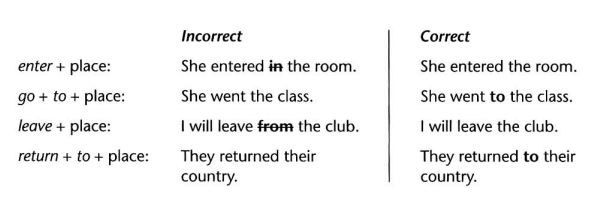
The word home does not use a preposition with verbs of motion.
- Incorrect: What time did you return
tohome? - Correct: What time did you return home?
Prepositions in Combination
Prepositions can be used to indicate place, time, and direction. In addition, prepositions can be used with certain nouns, verbs, and adjectives. You need to memorize these combinations and practice them in your writing and conversation.
Prepositions and Nouns
- Some prepositions are used before certain nouns: in trouble
- Some prepositions are used after certain nouns: a question about
There is no rule to explain these combinations. You must memorize them.
Preposition + Noun
 Noun + Preposition

If you use a verb form after a preposition, the verb must end in -ing. (This form is called a gerund, which is a verb form used as a noun. Here it is an object of the preposition.)
- Incorrect: Do you have any interest in
goto the lake with us on Saturday? - Incorrect: Do you have any interest in
to goto the lake with us on Saturday? - Correct: Do you have any interest in going to the lake with us on Saturday?
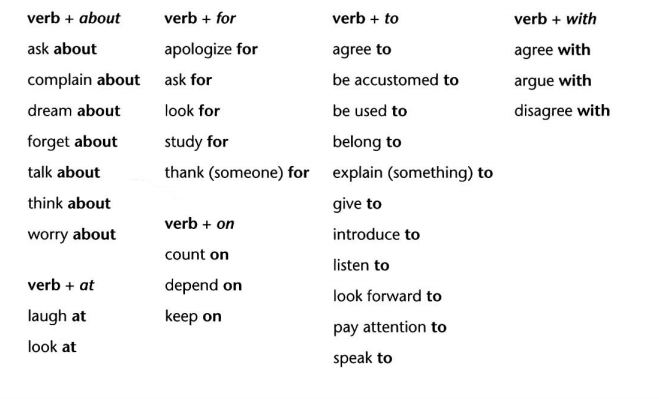
Prepositions and Verbs
Some prepositions are used after certain verbs: listen to, wait for, complain about
You must memorize these verb and preposition combinations.
- Incorrect: I complained the homework. (Problem: no preposition)
- Incorrect: I complained
forthe homework. (Problem: wrong preposition) - Correct: I complained about the homework.
O If you use a verb form after a preposition, the verb must end in -ing. (This form is called a gerund, which is a verb form used as a noun. Here it is an object of the preposition.)
- Incorrect: I complained about
dothe homework. - Correct: I complained about doing the homework.
Here are some common preposition and verb combinations
Prepositions and Adjectives
Some prepositions are used after certain adjectives: excited about
You must memorize these preposition and adjective combinations.

One of the most common errors is using the preposition for too often.
- Incorrect: We are happy
forthe professor’s decision. - Correct: We are happy about the professor’s decision.
If you use a verb form after a preposition, the verb must end in -ing. (This form is called a gerund, which is a verb form used as a noun. Here it is an object of the preposition.)
- Incorrect: We are worried about
flyto New York in January. - Correct: We are worried about flying to New York in January.
Here are some common prepositions of time.
|
after |
between |
for |
on |
to |
|
at |
by |
from |
past |
till |
|
before |
during |
in |
since |
until |
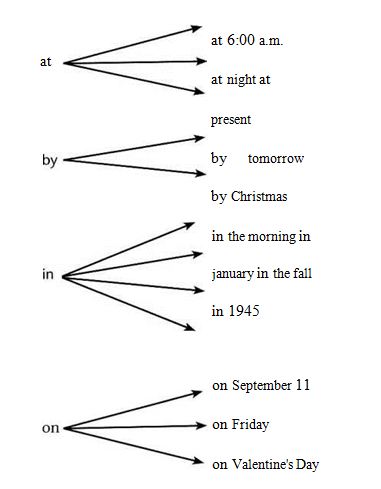
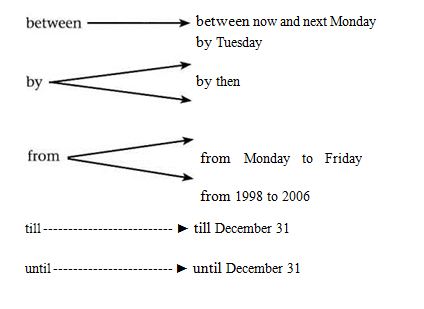
We use for with a general period of time and we use during with the name of a period of time. We use for to answer the question How long? and we use during to answer the question When?
- Incorrect: They visited France
duringtwo weeks. - Correct: They visited France for two weeks.
- Correct: They visited France during the summer.
Prepositions of Length of Time
The prepositions for, since, and during indicate a period of time.
FOR Use with a quantity, or period, of time.

SINCE Use with the exact beginning of a period of time.
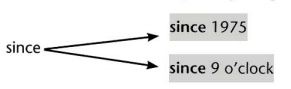
DURING Use with the name of a period of time.
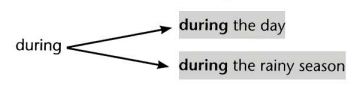
In English, “a half” comes before the time word. We say “five and a half hours,” not “five hours and a half.“
The post English Grammar: Lesson 20 (Part 4) – Prepositions of Time first appeared on Helena Daily English.]]>Place Time
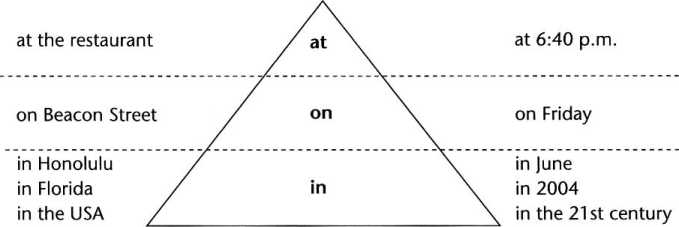
PLACES: very specific place, especially with the name of the place
- at Jefferson Community College
- at the Hilton
- at Pizza Hut
TIMES: very specific time; clock time
- at 10:1 7 a.m.
- at noon
- at midnight
- STREETS
STREETS:
- on Kennedy Avenue
- on Smith Street
- on Interstate
DAYS
- on Monday
- on June 17
- on my birthday
LARGE PLACES
- in Chicago
- in Illinois
- in the Northeast
- in North America
- in my neighborhood
LARGE TIME PERIOD
- in October
- in spring
- in the 1970s
- in the 18th century
- in these two weeks
Exception with the parts of a day:
in the morning, in the afternoon, in the evening, at nighy
Idiomatic Expressions with at, on, in
Here are some idiomatic uses of prepositions of location that you may need to memorize.
|
IN vs ON: |
in bed (sleeping) |
on the bed (sitting) |
|
AT vs IN: |
at the hospital (visiting, working) |
in the hospital (a patient) |
|
|
at the school (visiting, working) |
in school (a student) |
|
AT: |
at home |
|
|
|
at work |
|
|
IN: |
in class |
|
Different Meanings for at, in, and on
- Sometimes the meaning of a preposition is easy to understand.
- The clerk put the shirt in a white box. The box is on the table.
In this example, in means inside something and on means on top of something.
- My cousin works at Washington Bank. He works in the Accounting Department.
In this example, at means at a specific location and in means in a larger unit (for example, a department or an office).
- Sometimes the meaning of a preposition is not clear.
I bought my car in 2005.1 bought my car on my birthday.
Why do we say in 2005 and not on 2005? Why do we say on my birthday and not in my birthday? (Answer: We use in with years and on with dates.)
The post English Grammar: Lesson 20 (Part 3) – Describing Place and Time with at, on, in first appeared on Helena Daily English.]]>| about | This book is about a cat and a dog. |
| above | There is a cloud above the mountain. |
| across | I am going to swim across the lake. |
| after | If you arrive after 6:00 p.m., there might not be any more food. |
| against | We are against the president’s plan to raise taxes. |
| along | Yellow flowers grow along the river. |
| around | The dog ran around the tree several times. |
| as | For Halloween, she dressed up as a clown. |
| at (+ place)
(+ time) before |
The hotel is at 330 Wilson Avenue.
Flight 62 from Buenos Aires arrives at 9:37 p.m. I came home before midnight. |
| behind | The cat is sleeping behind the car. |
| below | The temperature last night dropped below 32 degrees! |
| beside | My apartment building is beside the highway. |
| between | I’m sitting between Jose and Chen. |
| by (+ time)
(+ -self) |
You must complete this assignment by tomorrow.
Do you live by yourself? |
| (+ place)
despite down |
The museum is located by a park and a lake.
We went to the beach despite the cloudy weather. The truck rolled down the embankment. |
| during | During his entire vacation, Mike had a terrible cold. |
| except
for (+ person) (+ period) from |
I like all animals except snakes and lizards.
This present is for you. We stayed in Toronto for five days. This semester lasts from January to May. |
| in (+ place)
(+ time) |
Trenton is in New Jersey.
Halloween is in October. |
| (+ period)
in back of |
Please come back in twenty minutes.
I think your book is in back of the computer. |
| in front of | I can’t find my keys. They were in front of the computer. |
| in spite of
instead of |
We went to the beach in spite of the cloudy weather.
Can you bring me some tea instead of coffee? |
| like | I think that turkey tastes like chicken. |
| near | Near the library, there is a large parking lot. |
| next to | Nevada is next to California. |
| of | What is the name of your professor? |
| off | You should take your hat off your head when you enter a building. |
| on (+ surface) | There are two maps on the classroom wall. |
| on (+ street) | My house is on Glenwood Drive. |
| since | My wife and I have lived here since 1998. |
| through | Suddenly a bird flew through the window. |
| to | I’m going to the library now. |
| under | Your notebook is under the computer. |
What Are Prepositions and Prepositional Phrases?
A preposition is a word that shows the relationship between a noun (or pronoun) and the rest of the sentence. Prepositions have many purposes, but they often give us information about place, time, and direction.
- place: in the classroom, on the table, near the bank, at the bank, under the table
- time: in the morning, in March, in 1985, in ten minutes, for ten minutes, at 9:45, on Monday
- direction: to the bank, from the bank
The combination of a preposition and its object (and any modifiers such as articles or adjectives) is called a prepositional phrase.
at home under the sofa on the green table
PREP + OBJ PREP + ARTICLE + OBJ PREP + ARTICLE + ADJECTIVE + OBJ
A prepositional phrase can come at the beginning, middle, or end of a sentence.
- beginning: In central Canada, the weather can be incredibly cold.
- middle: Vicky studied French in central Canada in 2005 and 2006.
- end: Dr. Ian Palmer teaches at a large university in central Canada.
Note that we usually use a comma after a prepositional phrase that comes at the beginning of a sentence.
- beginning (with comma): In the last century, air pollution damaged our forests.
- end (with no comma): Air pollution damaged our forests in the last century
1. Modals of Possibility and Probability
may might could should ought to must will be going to
Modals of possibility and probability indicate degrees, from a chance or possibility (50%) to definite (100%):
MAY / MIGHT / COULD 50% possibility
- It’s short notice, but we may / might / could go to the concert on Friday if Steve gets tickets.
SHOULD / OUGHT TO better possibility
- Lori should / ought to get to class on time today because there is no traffic on the highway.
MUST almost certain
- The football game is not sold out, so tickets must be available.
WILL / BE GOING TO definite
- Steve bought tickets, so we will attend / are going to attend the concert Friday night.
2. Modals of Advisability and Suggestion
should ought to had better (threat)
Use modals to give someone advice or make a suggestion:
SHOULD advice or suggestion
- You should take an umbrella.
- You shouldn’t get so angry; it was a mistake.
OUGHT TO strong advice
- Dan ought to take the train because parking spaces are scarce.
HAD BETTER warning or threat
- Michael had better stop smoking; otherwise, it could affect his health.
The negative form is had better + not.
- You had better not / You‘d better not do that.
3. Negative Modals
| In formal writing, negatives are formed by inserting DO / DOES + not before the verb.
When you use a modal, not comes after the modal. Remember that in formal writing, contractions are not generally used. |
|
|
|
| Here are the negative modals: | |
| would + not = wouldn’t | have to + not = do not have to = don’t have to |
| should + not = shouldn’t | has to + not = does not have to = doesn’t have to |
| can + not = cannot = can’t | could + not = couldn’t |
| may + not = may not (no contraction) | will + not = won’t |
| ought to + not = ought not (no contraction) | must + not = mustn’t |
| be able to + not = am not able to (no contraction), isn’t, aren’t, wasn’t, weren’t able to | might + not = might not (usually not contracted) |
- When something is NOT NECESSARY, use do not have to / doesn’t have to / don’t have to.
- I feel a lot better. I do not have to take any more medication.
- The meeting was canceled; she does not have to go.
- You don’t have to shout; I can hear just fine.
- Must + not (mustn’t) is used for prohibition (a very strong warning).
- Children must not sit close to the television. It will damage their eyesight.
- You mustn’t smoke in restaurants in this state. Smoking in public places is against the law.
4. Questions with Modals
Questions use inverted word order. Sentences with modals form questions by putting the modal first.
- I can go to the movies with you. / Can I go to the movies with you?
- John was able to fix his computer. / Was John able to fix his computer?
Do not use do / does / did with one-word modals in statements or questions.
- Incorrect: Sasha
doescan drive the car pool tomorrow. - Correct: Sasha can drive the car pool tomorrow.
- Incorrect:
Doyou should call the doctor? - Correct: Should you call the doctor?
1. What Are Modals?
Modals are words that help main verbs by changing the meaning of the sentence. Modals are used to express:
| 1 | requests and permission | Can you stop at the grocery store on the way home? |
| 2 | ability | When I was a child, I could run very fast. |
| 3 | necessity | International students must have a student visa in the United States. |
| 4 | possibility and probability | We might go to the beach this weekend. |
| 5 | advisability and suggestion | The lecturer should speak more clearly. |
The most common modals are can, could, may, might, should, would, ought to, must, have to, and be able to. Remember that all modals are followed by the base form of the verb.
- I ride my bike to school. (This is something that I do every day.)
- I may ride my bike to school. (It is possible that I will ride my bike, or I may not. A second meaning is that I have permission [from my parents, for example] to ride my bike to school.)
- I can ride my bike to school. (I have the ability to ride.)
- I must ride my bike to school. (This is a necessity; I have no other transportation.)
Only use the base form of the verb after the modal.
- Incorrect: Margaret will
tograduate next year. - Correct: Margaret will graduate next year.
- Incorrect: The students should
tostudy - Correct: The students should study
Do not add -s to the base verb following a modal.
- Incorrect: He can use
sthe computer in the living room. - Correct: He can use the computer in the living room.
- Incorrect: Lucille would help
s, if she had the time. - Correct: Lucille would help if she had the time.
Some modals are combinations of more than one word. For these multiword modals, such as be able to and have to, you must change form according to the subject.
- My dog is able to jump over the fence in the backyard.
- We have to change the flat tire.
Do not use two one-word modals together in a sentence.
- Incorrect: You may
caneat at my house. - Correct: You may eat at my house, (permission – formal)
You can eat at my house, (permission – informal)
You can combine a one-word modal with a multiword modal.
- Ex: I may be able to help you tomorrow.
- Ex: We might have to leave the party early.
2. Modals for Requests and Permission
can could would may might
When you use modals to ask for something, you politely request, or ask for permission.
CAN informal
- Can I use your cell phone? (request)
- Joe can go next; I don’t mind waiting, (permission)
COULD informal
- Could you close the window? (request)
- You could park here, (permission)
WOULD polite request
- Would you like to go to the movies tonight? (request)
- Would you mind if I sit here? (request for permission)
MAY formal
- May I have your name, please? (request)
- You may have a seat, (permission)
MIGHT very formal (not commonly used)
- Might I offer you a piece of candy? (request; not used for permission)
Requests are usually questions. The modal comes first in a question.
- Can I have some?
Do not use two one-word modals together in a sentence.
- Incorrect: You may
canborrow my car. - Correct: You may borrow my car. (permission – formal)
- You can borrow my car. (permission – informal
3. Modals of Ability
can could (past ability) be able to
These modals express ability. All three modals are followed by the base form of the main verb. Only be able to changes for third person singular. Can and could do not add -s.
CAN ability
- Harry can run faster than Jim.
COULD ability, past tense
- Carmen could recite the alphabet as a young child.
BE ABLE TO have the ability to
- I am able to drive without my glasses, (present)
- Carol is able to drive without her glasses, (present – third person singular)
- We were not able to get a reservation, (past, negative)
- Peter was able to make the reservation, (past – third person singular)
Do not use two one-word modals in a sentence.
- Incorrect: I
can couldhelp you tomorrow. - Correct: I can help you tomorrow, (ability)
- Correct: I could help you tomorrow, (possibility – different meaning)
4. Modals of Necessity
must have to have got to need to
Use these modals when something is required or necessary:
MUST very strong
- Tomorrow is the final exam; everyone must attend class.
HAVE / HAS TO used more often than must
- Luis has to sell his motorcycle before he buys a boat.
HAVE / HAS GOT TO (very informal)
- Anna is staying home from the party because she has got to study.
NEED TO similar to HAVE / HAS TO
- I need to get a new pair of reading glasses.
The post Learn English Grammar: Lesson 18 (Part 1) – Modals first appeared on Helena Daily English.]]>
1. Subject-Verb Agreement: Witb Indefinite Pronouns
A pronoun usually replaces a specific noun. For example, you can use she instead of my sister. However, one group of pronouns does not refer to a specific noun. We call these indefinite pronouns. Examples of indefinite pronouns are someone and everybody.
Below is a list of common indefinite pronouns. Note that when indefinite pronouns are the subject of a sentence, they ALWAYS take a singular verb.
| every- | some- | any- | no- | |
| -one | everyone | someone | anyone | no one |
| -body | everybody | somebody | anybody | nobody |
| -thing | everything | something | anything | nothing |
- Everybody likes our new teacher Dr. Olsen.
- Something smells strange in the refrigerator.
- Anyone is welcome to the party
2. Subject + Prepositional Phrase + Verb
When the subject and the verb are separated by other words in a sentence, it can be difficult to make the subject and the verb agree. Sometimes subjects and verbs are separated by prepositional phrases that give additional information about the subject. When you are writing, be sure to connect the subject and the verb even if additional words separate them.
Ex: The little girl lives on Hudson Street.
SUBJECT VERB
The little girl in the blue and white sweater lives on Hudson Street.
SUBJECT PREPOSITIONAL PHRASE VERB
The houses near the supermarket are not for sale.
SUBJECT PREPOSITIONAL PHRASE VERB
Some common prepositions include in, near, at, on, to, and from.
3. Subject-Verb Agreement: With there + he
When we want to explain that something exists, we use the form there+be. The subject of the sentence is generally found after the verb be.
there + be + subject
Present tense: There is a huge delay on the highway right now.
VERB SUBJECT
There are almost 300,000,000 people in the United States. VERB SUBJECT
Past tense: There were five concerts at the amphitheater last weekend.
VERB SUBJECT
There was a problem at work, so I had to stay late.
VERB SUBJECT
When using there + be, remember to find the subject and make sure that it agrees with the form of be.
The post Learn English Grammar: Lesson 17 (Part 2) – Subject-Verb Agreement first appeared on Helena Daily English.]]>
-
Subject-Verb Agreement: Present Tense Verbs
When you describe something using the simple present tense, the subject must agree with its verb in number (singular or plural) and person.
Singular
- I ride city buses.
- You ride city buses.
- My sister rides city buses.
Plural
- We ride city buses.
- You ride city buses.
- My brother and my sister ride city buses.
2. Subject-Verb Agreement: Negative Verbs
When you want to express a negative thought in the present tense, you must add the helping verb do or does (plus the negative not) to sentences that do not already have a helping verb.
Do not use do or does when the main verb is be.
- Singular (positive): My sister rides city buses.
- Singular (negative): My sister does not ride city buses.
- Plural (positive): My brothers live in New York City.
- Plural (negative): My brothers do not live in New York City.
When you use the third person singular in the negative, you must use does not (doesn’t). All other forms use do not (don’t).
In formal writing, it is best not to use contractions (doesn’t or don’t).
In the negative form, use does; never put -s on the main verb.
- Incorrect: My sister does not rides, city buses.
- Incorrect: My sister do not rides, city buses.
- Incorrect: My sister no rides city buses.
- Correct: My sister does not ride city buses.
3. Subject-Verb Agreement: With be (present tense)
Sentences that contain be in the present tense use the following forms:
|
Here are the forms for negative sentences:
| Person | Singular | Plural |
| First | I am not a college student. | We are not (aren’t) college students |
| Second | You are not (aren’t) a college student. | You are not (aren’t) college students. |
| Third | He is not (isn’t) a college student. | They are not (aren’t) college students. |
4. Subject-Verb Agreement: With be (past tense)
| Sentences that contain be in the past tense use the following forms: | ||
| Person | Singular | Plural |
| First | I was in class yesterday. | We were in class yesterday. |
| Second | You were in class yesterday. | You were in class yesterday. |
| Third | She was in class yesterday. | They were in class yesterday. |
| Here are the forms for negative sentences: | ||
| Person | Singular | Plural |
| First | I was not (wasn’t) in class yesterday. | We were not (weren’t) in class yesterday. |
| Second | You were not (weren’t) in class yesterday. | You were not (weren’t) in class yesterday. |
| Third | She was not (wasn’t) in class yesterday. | They were not (weren’t) in class yesterday. |
The post Learn English Grammar: Lesson 17 (Part 1) – Subject-Verb Agreement first appeared on Helena Daily English.]]>Learn English Grammar: Lesson 17 (Part 2) – Subject-Verb Agreement
There are two ways to show the possessive of nouns in English. One way is with an apostrophe and the letter s (‘s). The other way is with the preposition of. Consider the differences between these two possessive forms.
For people:
- A singular noun that does not end in -s: add ‘s
- the boy has a book = the boy’s book
- the boy has books = the boy’s books
- A plural noun that ends in -s: add ‘ (apostrophe)
- the boys have one book = the boys’ book
- the boys have many books = the boys’ books
- An irregular plural noun: add ‘s
- the children have a book = the children’s book
- people have opinions = people’s opinions
- A name that ends in -s: add ‘s
- Chris has a laptop = Chris’s laptop
- Charles has two bikes = Charles’s bikes
For things:
- Use of instead of ‘s
- a table has a top = the top of the table
- a book has a title = the title of the book
- Exceptions: We use ‘s for time words and nature words
- Today’s newspaper is on the table.
- The sun’s rays provide us with warmth and vitamin D.
The post Learn English Grammar: Lesson 16 – Possessive Forms of Nouns first appeared on Helena Daily English.]]>Learn English Grammar: Lesson 17 (Part 1) – Subject-Verb Agreement